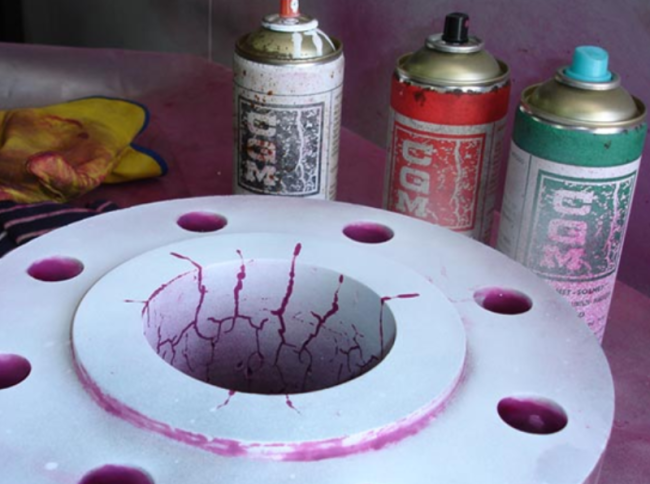
Liquid penetrant testing is one of the oldest and simplest NDT methods where its earliest versions (using kerosene and oil mixture) dates back to the 19th century.
This method is used to reveal surface fluorescent dye from the flaw.
The Tehnique is based on the ability of a liquid to be drawn into "clean" surface discontinuity by capillary action.
The advantage that a liquid penetrant inspection offers over an unaided visual inspection is that it makes defects easier to see for the inspector.
its produces a flaw indication that is much larger and easer for the eye to detect than the flaw itself.
Many flaws are so small or narrow that they are undetectable by the unaided eye (a person with a perfect vision can not resolve features smaller than 0.08 mm).
It improves the detectability of a flaw due to the high level of contrast between the indication and the background which helps to make the indication more easily seen (such as a red indication on a white background for visible penetrant or a penetrant that glows under ultraviolet light for fluorescent penetrant).
Liquid penetrant testing is one of the most widely used NDT methods.
Its popularity can be attributed to two main factors: its relative ease of use and its flexibility.
It can be used to inspect almost any material provided that its surface is not extremely rough or porous.
Materials that are commonly inspected using this method include; metals, glass, many ceramic materials, rubber and plastics.